How to Ethically Review Digital Products Without Misleading Readers: A Guide for Honest Content Creators
Learn how to write honest, ethical digital product reviews with transparent disclosures, evidence-based testing, and FTC-compliant practices.
Osita
1/7/20267 min read
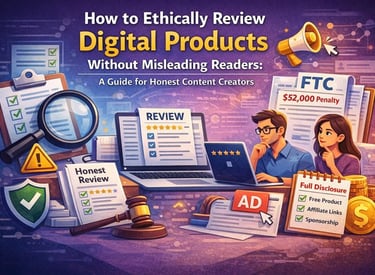
How to Ethically Review Digital Products Without Misleading Readers: A Guide for Honest Content Creators
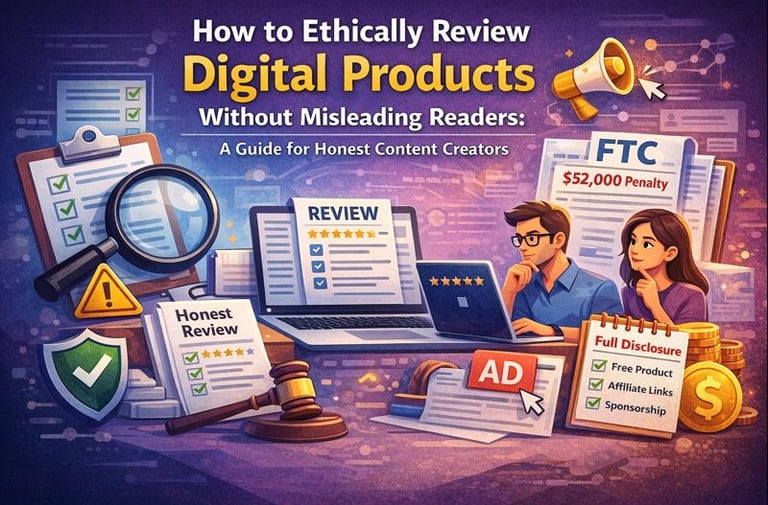
Online reviews shape purchasing decisions for millions of consumers, but the digital landscape is flooded with fake, incentivized, and misleading content that erodes trust. When you write reviews for digital products, you hold significant influence over your readers' choices and their financial decisions. Understanding how to review ethically isn't just about avoiding legal trouble—it's about maintaining credibility and providing genuine value to your audience.
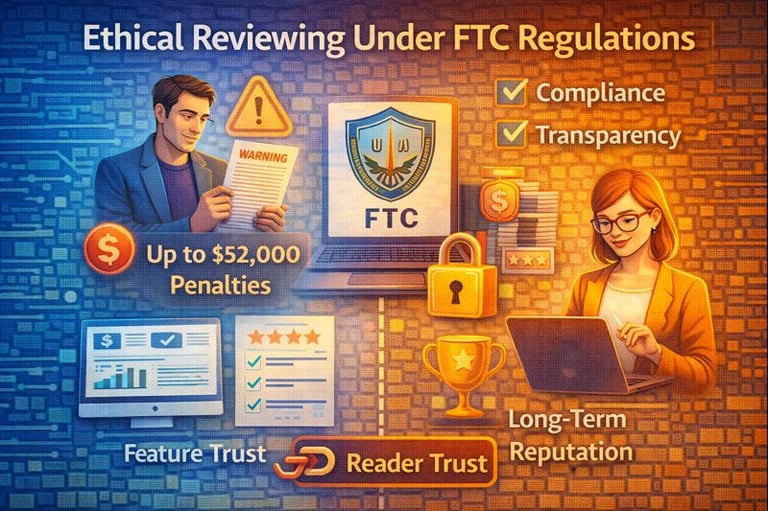
Ethical digital product reviews require transparency about your relationship with products, honest assessments based on actual use, and transparent disclosure of any compensation or incentives you receive. The stakes have risen considerably with new FTC regulations imposing penalties of up to $52,000 for deceptive review practices. Both individual reviewers and businesses face scrutiny under these updated rules.
This guide walks you through the foundations of ethical reviewing, common pitfalls that mislead readers, and practical strategies for building lasting trust with your audience. You'll learn how to navigate disclosure requirements, avoid legal complications, and establish yourself as a reviewer who prioritizes reader welfare over quick profits or brand relationships.
Foundations Of Ethical Digital Product Reviews
Ethical digital product reviews rest on three pillars: taking responsibility for your influence on purchasing decisions, maintaining transparency about your relationships and limitations, and presenting evaluations that distinguish between measurable facts and personal preferences.
Understanding Reviewer Responsibility
Your reviews directly influence how readers spend their money and time. When you publish an assessment of a digital product, you shape market perceptions and consumer choices. This influence carries an obligation to test products thoroughly before forming conclusions.
You must use products under real-world conditions for a sufficient time. Quick impressions after minimal use fail to reveal performance issues, learning curves, or long-term reliability concerns. Your credibility depends on investing the effort required to understand how a product performs across different scenarios and use cases.
Key responsibilities include:
Testing all major features and functions before publishing
Documenting actual performance metrics when possible
Acknowledging limitations in your testing methodology
Correcting errors or outdated information promptly
Declining to review products you cannot adequately evaluate
You should disclose your level of expertise with similar products. A beginner's perspective differs fundamentally from an expert assessment, and readers need this context to interpret your conclusions correctly.
Importance Of Transparency And Disclosure
Readers deserve to know about any relationships, compensation, or circumstances that could influence your review. You must disclose these factors clearly and prominently, not buried in footnotes or separate pages.
Mandatory disclosures include:
Free products or services received for review
Affiliate commissions from product links
Sponsorship or advertising relationships
Personal or professional connections to the company
Financial stakes in competing products
Place disclosures at the beginning of your review where readers see them immediately. Generic disclosure statements fail to meet ethical standards. You need specific information about the exact nature of your relationship with each product you review.
You should also reveal testing limitations. If you only used a product for three days, had technical difficulties, or couldn't test certain features, state this explicitly. Readers need to understand the boundaries of your evaluation.
Balancing Objectivity And Subjectivity
Effective reviews separate verifiable facts from personal opinions. You must distinguish between measurable product characteristics and your subjective experience. Facts include specifications, performance benchmarks, feature lists, and pricing. Opinions cover user experience, design preferences, and value judgments.
Use precise language to mark this distinction. Phrases like "I found" or "in my experience" signal subjective observations—state objective facts directly without qualifying language.
Present objective data through:
Technical specifications from manufacturer documentation
Standardized test results and benchmarks
Feature comparison tables
Actual measurements and timings
Verified compatibility information
Your subjective perspective adds value when you explain your reasoning. Rather than simply stating a product feels "slow," describe specific situations where performance lagged and provide context about your expectations. This approach lets readers determine whether your concerns apply to their needs.
You maintain objectivity by acknowledging that different users have different requirements. A feature you consider essential might be irrelevant to others. Your review should help readers make informed decisions based on their priorities, not impose your preferences as universal truths.
Preventing Misleading Practices In Reviews
Misleading review practices damage reader trust and can violate Federal Trade Commission regulations that prohibit fake, incentivized, or deceptive testimonials. Clear disclosure standards, balanced language, and factual accuracy protect both your audience and your credibility as a reviewer.
Avoiding Biased Or Promotional Language
Your word choices directly affect how readers perceive product information. Replace exaggerated terms like "revolutionary," "game-changing," or "life-altering" with specific descriptions of what the product does. Instead of writing "this amazing software transforms productivity," state "this software reduced task completion time by 30% in our tests."
Promotional language often appears in subtle forms. Watch for phrases that sound like marketing copy: "you won't believe," "absolutely must have," or "the only solution you'll ever need." These phrases signal bias rather than objective assessment.
Quantify claims whenever possible. Rather than calling features "excellent" or "poor," describe their performance with measurable data. When testing isn't possible, acknowledge your limitations rather than making assumptions.
Properly Citing Sponsorships And Partnerships
You must disclose any financial relationship with product creators before discussing features or benefits. The FTC requires clear, conspicuous disclosure that appears before affiliate links or purchase recommendations, not buried in footers or separate pages.
Required disclosures include:
Free products received for review
Affiliate commission arrangements
Direct sponsorship payments
Partnership agreements
Stock ownership in the company
Personal relationships with creators
Place disclosures at the beginning of your review in plain language. Write "I received this product free from Company X" or "I earn commission on purchases through links in this review." Vague statements like "some links may be compensated" fail FTC standards.
Update disclosure statements when relationships change. If you later establish a partnership with a company whose product you previously reviewed independently, add disclosure to the original content.
Accurately Presenting Features And Limitations
Present both capabilities and shortcomings with equal weight. Readers need complete information to make informed decisions, not a curated list of positive attributes. Document specific scenarios where the product succeeded and failed during your testing.
Create comparison tables that show objective feature availability rather than subjective rankings:
Storage Capacity
500GB
1TB
Monthly Cost
$9.99
$14.99
Mobile App
Yes
No
Distinguish between temporary issues and fundamental limitations. A bug that developers plan to fix differs from architectural constraints that won't change. State version numbers when reviewing software, since features vary across releases.
Test products under realistic conditions that match your audience's likely usage. Document your testing environment, duration, and methodology so readers can assess whether your experience applies to their situation.
Ensuring Evidence-Based Claims
Support every performance claim with verifiable data from your own testing or cited sources. "Fast loading times" means nothing without numbers. "Pages loaded in an average of 1.2 seconds across 50 tests" provides actionable information.
Screenshot evidence proves feature availability and interface design. Performance benchmarks require multiple test runs under consistent conditions. When comparing products, test them simultaneously using identical parameters.
Separate factual observations from opinions. Write "the interface uses a three-column layout" as fact, then "I found the layout cluttered" as clearly marked personal preference. Attribute subjective statements to yourself rather than presenting them as universal truths.
Avoid extrapolating beyond your experience. If you tested a product for 2 weeks, don't claim to know its long-term reliability. Link to manufacturer specifications for claims you cannot personally verify, and note that you're citing external sources rather than confirming through testing.
Best Practices For Building Reader Trust
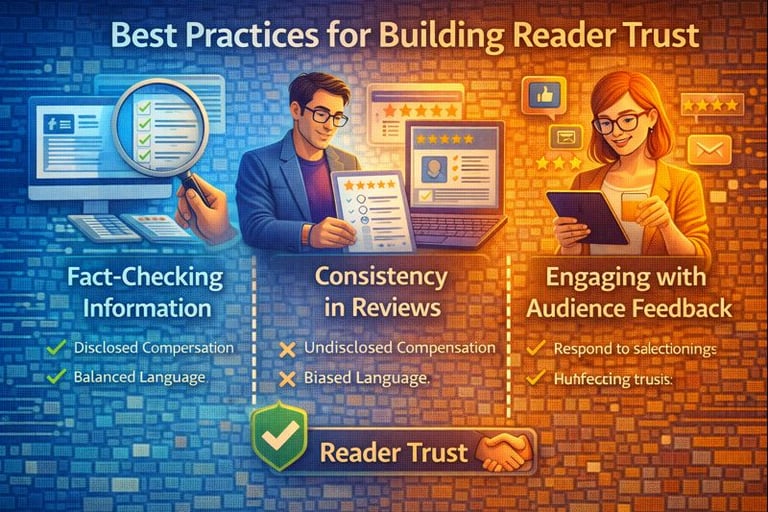
Trust forms the foundation of ethical product reviews. Readers rely on your accuracy, consistency, and willingness to listen when making purchasing decisions based on your recommendations.
Fact-Checking Information
Verify every claim you make about a product before publishing your review—cross-reference specifications with manufacturer websites, official documentation, and multiple reliable sources to ensure accuracy.
Test products yourself whenever possible rather than relying solely on secondary information. Direct experience allows you to confirm features work as advertised and catch discrepancies between marketing claims and actual performance.
Document your testing process and keep records of product versions, firmware updates, and testing dates. Technology changes rapidly, and what's true today may not hold for future versions of the same product.
When you can't verify something directly, acknowledge this limitation explicitly. State clearly whether information comes from manufacturer claims, user reports, or your own testing. This transparency helps readers assess the reliability of different aspects of your review.
Correct errors promptly when you discover them. Add dated updates to reviews and notify readers through your usual channels about significant corrections.
Maintaining Consistency Across Reviews
Apply the same evaluation criteria to all products within a category. Create a standard checklist of features, performance metrics, and user experience factors you assess for each review.
Use consistent rating scales and explain what each rating level means. If you rate a budget product 4/5 stars, readers should understand how that compares to a premium product with the same rating, given different expectations for each price tier.
Key consistency elements:
Testing methodology
Rating criteria
Price-to-value assessment framework
Disclosure placement and format
Update frequency for older reviews
Your tone and objectivity should remain steady regardless of whether you received a product for free, purchased it yourself, or received compensation for the review. Readers notice when enthusiasm levels vary suspiciously between sponsored and non-sponsored content.
Engaging With Audience Feedback
Respond to reader comments and questions about your reviews. Address concerns about accuracy, ask for clarification when readers report different experiences, and thank people for contributing additional information.
Create channels for readers to report issues with products you've reviewed. Their real-world experiences over time provide valuable data that supplements your initial testing period.
Update reviews based on legitimate reader feedback. If multiple readers report a problem you didn't encounter, investigate and add this information to your review with appropriate context.
Acknowledge when you disagree with reader opinions, but do so respectfully and with explanation. Different use cases and priorities lead to different conclusions about the same product.
Legal And Reputational Considerations For Reviewers
Reviewers face specific legal obligations and reputational risks that can affect both their credibility and potential liability. Understanding these boundaries helps you maintain professional standards while protecting yourself from legal challenges.
Complying With Industry Guidelines
The FTC requires disclosure of material connections between reviewers and product creators. You must clearly state if you received compensation, free products, or affiliate commissions before readers encounter your review content.
Key disclosure requirements include:
Placing disclosures before affiliate links or purchase recommendations
Using clear language like "I received this product for free" rather than vague terms
Disclosing ongoing relationships with brands or companies
Making disclosures visible on all platforms, including social media posts
Professional reviewer organizations and platforms often maintain additional standards. These guidelines typically address objectivity requirements, testing procedures, and expectations for content accuracy. Following established industry standards strengthens your credibility and demonstrates professional integrity.
Your disclosures must be immediate and unavoidable. Burying them in footnotes or requiring users to click to view them violates FTC guidelines.
Understanding Potential Liabilities
Defamation represents the primary legal risk for reviewers. You can face lawsuits if you publish false statements that harm a company's reputation, even if you believed the statements were factual.
Protection strategies include:
Documenting your testing process and keeping detailed records
Distinguishing clearly between factual claims and personal opinions
Verifying factual statements before publication
Avoiding inflammatory language that suggests malicious intent
Truth serves as a complete defense against defamation claims in most jurisdictions. However, you bear the burden of proving your statements are accurate if challenged legally.
Your professional reputation depends on maintaining consistent ethical standards. Publishing misleading reviews damages reader trust and can result in platform bans, loss of partnerships, and diminished authority in your niche. Courts may also consider your history of accurate reporting when evaluating disputes.