Why Niche Focus Beats General Product Reviews Every Time: The Data-Driven Case for Specialized Content
Instead of competing with massive review platforms on surface-level content, you’ll learn how niche expertise creates deeper insights, stronger engagement, and long-term growth. Backed by real-world performance metrics and practical examples, this guide shows why specialized reviewers win in credibility, SEO rankings, and revenue—even with smaller audiences.
Osita
1/26/20268 min read
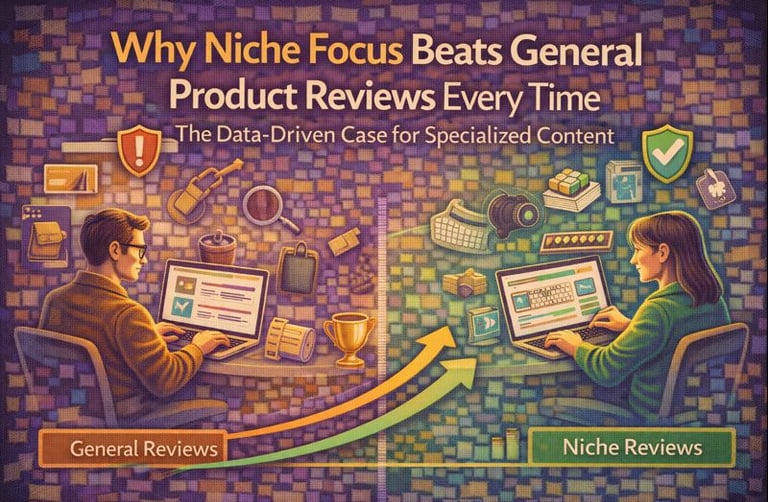
Why Niche Focus Beats General Product Reviews Every Time: The Data-Driven Case for Specialized Content
Product reviewers face a critical choice: cast a wide net across multiple categories or specialize in a specific niche. Focusing on a narrow market segment allows you to build deeper expertise, establish stronger credibility with your audience, and create more valuable content than spreading yourself thin across general product reviews. This approach transforms you from just another reviewer into a trusted authority within your chosen field.
General product review sites struggle to differentiate themselves in an oversaturated market. When you review everything from kitchen appliances to electronics to fitness equipment, your audience never knows what to expect, and search engines struggle to understand your expertise. You compete against massive platforms with unlimited resources while offering similar surface-level insights.
A niche focus changes this dynamic entirely. By concentrating on a specific product category or audience segment, you develop specialized knowledge that general reviewers cannot match. Your recommendations become more nuanced, your comparisons more relevant, and your audience more loyal. This strategic approach leads to measurable benefits including higher engagement rates, better conversion performance, and sustainable growth in a competitive landscape.
Understanding Niche Focus in Product Reviews
Niche product reviews target specialized markets with specific audience needs, while general reviews attempt to serve everyone. The distinction between these approaches affects review depth, audience engagement, and purchasing decisions.
Defining Niche Product Reviews
Niche product reviews concentrate on specialized products within a narrow market segment. These reviews address the unique requirements of a targeted consumer group rather than appealing to a broad audience.
When you read a niche review, you encounter detailed analysis tailored to specific use cases. A niche review site about mechanical keyboards serves enthusiasts who care about switch types, actuation force, and keycap materials. This specificity allows reviewers to develop expertise in their chosen area.
The focused approach enables reviewers to understand product nuances that general reviewers miss. You get insights from someone who has tested dozens of similar products and knows what matters to your specific needs. Niche reviewers build authority by consistently covering products within their specialty rather than jumping between unrelated categories.
Distinguishing Niche and General Reviews
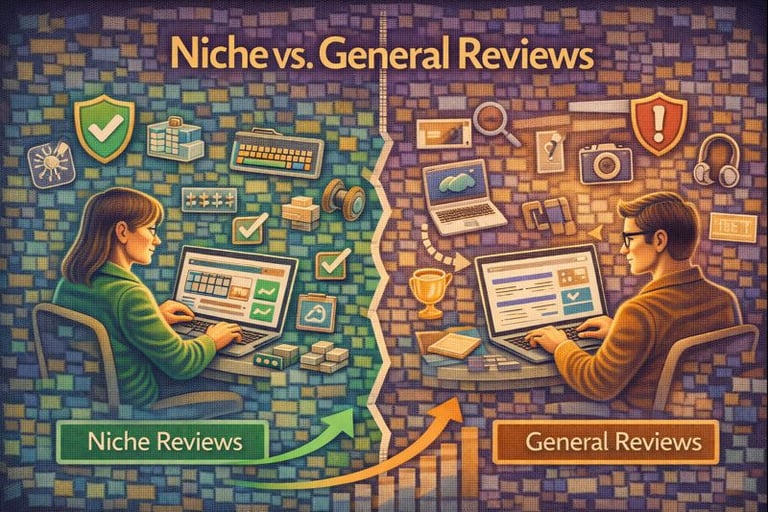
General reviews cover broad product categories like "electronics" or "home goods" with surface-level analysis. Niche reviews dive deep into subcategories like "studio headphones for mixing engineers" or "cast iron cookware for outdoor cooking."
The key differences appear in several areas:
Audience specificity: Niche reviews target people with particular interests or problems. General reviews aim for mass appeal.
Technical depth: Niche reviewers use industry terminology and discuss specialized features. General reviewers keep explanations basic to remain accessible.
Comparison context: Niche reviews compare products against others in the same specialized category. General reviews make broader comparisons across product types.
Trust and expertise: Your confidence in niche reviewers grows because they demonstrate consistent knowledge in their field. General reviewers spread their attention thin across many categories.
Common Types of Niche Review Sites
Review sites typically specialize in one of several niche categories based on audience characteristics or product types.
Hobby-based niches serve enthusiasts pursuing specific activities. Sites reviewing fly fishing gear, RC drones, or fountain pens fall into this category. These audiences value performance details and advanced features.
Problem-solving niches focus on products addressing particular challenges. Reviews of ergonomic office equipment for back pain or hypoallergenic pet products target people seeking specific solutions.
Demographic niches cater to distinct groups like seniors, new parents, or college students. Product recommendations consider the unique circumstances and priorities of these audiences.
Professional niches review tools and equipment for specific careers. Commercial kitchen equipment, construction tools, or photography gear sites serve professionals who need reliable performance data.
Advantages of Niche Product Reviews Over General Reviews
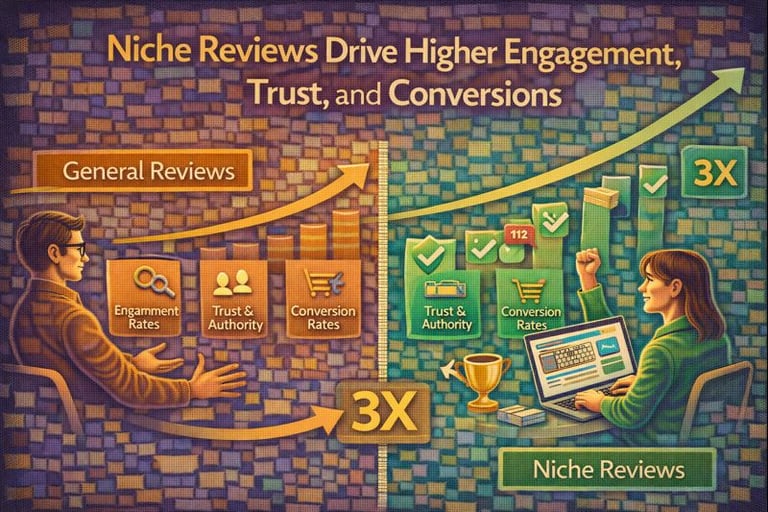
Niche product reviews deliver measurable benefits that general reviews cannot match. Specialized reviewers build stronger connections with their audience, demonstrate genuine expertise, establish credibility faster, and drive higher purchase rates.
Targeted Audience Engagement
When you focus on a specific niche, you attract readers who already care about your topic. These visitors arrive with intent, looking for detailed information that generic reviews cannot provide.
Your niche audience shares common problems, goals, and purchasing criteria. This allows you to address their exact pain points without wasting time on irrelevant details. A review of professional-grade kitchen mixers speaks directly to serious bakers, while a general appliance review tries to please everyone and satisfies no one.
Key engagement benefits:
Higher time-on-page metrics as readers find relevant content
More comments and questions from engaged visitors
Increased social shares within specialized communities
Lower bounce rates from qualified traffic
You can use industry-specific terminology without explaining basic concepts. Your readers appreciate this efficiency because they already understand the fundamentals and want advanced insights.
Deep Subject Matter Expertise
Niche reviewers develop genuine expertise through repeated exposure to similar products. You understand the nuances that matter to your audience because you evaluate products within a specific context.
A general tech reviewer might test fifty different product types annually. A niche reviewer examines fifty variations of the same product category. This concentrated experience reveals patterns, quality indicators, and performance differences that casual reviewers miss.
Your testing protocols become more sophisticated over time. You know which features matter most, which claims manufacturers exaggerate, and which specifications actually affect real-world performance. This depth transforms your reviews from surface-level observations into valuable analysis.
You can compare products against each other with authority. Your readers benefit from comparative insights based on hands-on experience with multiple options in the category.
Enhanced Authority and Trust
Specialization builds credibility faster than broad coverage. Your consistent focus on one area proves you care about the subject beyond casual interest.
Readers recognize authentic expertise versus manufactured content. When you demonstrate detailed knowledge across multiple reviews in the same category, you establish yourself as a reliable source. General reviewers lack this cumulative credibility because their attention spreads across unrelated products.
Brand partnerships and industry recognition follow naturally. Manufacturers seek out established niche reviewers for product launches and expert opinions. This access strengthens your authority further and provides early review opportunities that general sites cannot secure.
Your recommendation history becomes verifiable. Readers can check your past reviews to see if your assessments proved accurate over time.
Improved Conversion Rates
Niche reviews convert readers to buyers at significantly higher rates. Your audience arrives ready to purchase and needs only the right information to decide.
Conversion advantages:
Factor
Impact
Purchase intent
Visitors already committed to the category
Decision clarity
Specific comparisons aid selection
Trust level
Expertise reduces purchase hesitation
Relevance
Every detail applies to reader needs
Your affiliate commissions increase even with smaller traffic volumes. A niche review with 1,000 monthly visitors often generates more revenue than a general review with 10,000 visitors because the audience quality differs dramatically.
You can create buying guides that address specific use cases. This targeted approach helps readers match products to their exact situations, increasing satisfaction and reducing returns.
Building Credibility and Driving Growth With Niche Content
Niche content creates measurable advantages in establishing authority, fostering dedicated audiences, and generating consistent search visibility. These benefits compound over time as you deepen your expertise in a specific area.
Strengthening Brand Identity
When you focus on a specific niche, your brand becomes synonymous with expertise in that particular area. Your audience recognizes you as the go-to source for detailed, accurate information rather than just another reviewer covering everything.
This specialization allows you to develop a distinct voice and perspective. You learn the terminology, understand the nuances, and identify the questions your audience asks before they even articulate them. Your content reflects this depth through technical accuracy and practical insights that generalists cannot match.
Consistency in your niche reinforces recognition. When readers see your content, they immediately know what to expect and trust your recommendations because you've demonstrated repeated competence in that specific domain.
Key identity markers include:
Technical vocabulary used correctly
Knowledge of industry-specific problems
Awareness of product evolution and trends
Understanding of price-to-value relationships in your niche
Community Building in Specific Markets
Niche audiences form tighter communities because they share specific interests and challenges. Your focused content becomes a gathering point for these individuals who seek specialized knowledge.
You can engage more meaningfully with a smaller, targeted audience than with a broad, diverse one. Comments and discussions become substantive because everyone speaks the same language and cares about the same details. This engagement creates loyalty that translates to repeat visits and word-of-mouth growth.
Your community members often contribute their own expertise, enriching your content ecosystem. They share experiences, compare products, and help each other solve problems. You facilitate these connections while learning from their collective knowledge to improve your own content.
Sustainable Organic Traffic Gains
Niche content performs better in search engines because you can target long-tail keywords that match specific user intent. Instead of competing for "best headphones," you rank for "best open-back headphones for classical music under $300."
Search engines favor content that demonstrates expertise and relevance to specific queries. Your depth of coverage signals authority, leading to improved rankings that generalist content cannot achieve. Studies show niche optimization can improve organic search rankings by approximately 30%.
The traffic you gain from niche focus converts at higher rates because visitors find exactly what they need. They're not sifting through irrelevant information to find applicable advice. Your content answers their precise question, which reduces bounce rates and increases engagement metrics that further boost your search visibility.
Implementing a Successful Niche Review Strategy
Moving from general reviews to niche focus requires systematic planning and execution. Your success depends on selecting the right niche, creating sustainable content workflows, and tracking metrics that matter.
Identifying Profitable Review Niches
Start by analyzing markets where you already have expertise or genuine interest. Your credibility stems from authentic knowledge, not surface-level research.
Look for niches with specific buying intent. Product categories like ergonomic office chairs for remote workers or mirrorless cameras for wildlife photography demonstrate clear purchase readiness. These audiences actively seek detailed comparisons before spending money.
Evaluate competition realistically. Use keyword research tools to identify search volumes between 1,000-10,000 monthly searches. This range typically indicates sufficient audience size without overwhelming competition from major publications.
Key validation criteria:
Average product price above $100 (higher commission potential)
Regular new product releases (ongoing content opportunities)
Active online communities discussing purchases
Affiliate programs offering 5-10% or higher commissions
Avoid saturated niches like general tech gadgets or basic home appliances. The barrier to entry is too high and differentiation becomes nearly impossible.
Content Planning and Monetization
Build a content calendar around product categories, not individual items. Group reviews into comparison guides, buyer's guides for specific use cases, and long-term testing updates.
Create depth through testing protocols specific to your niche. If you review running shoes, establish consistent metrics: weight, heel-toe drop, durability after 100 miles, performance in wet conditions. Your audience values standardized evaluation.
Revenue streams to implement:
Affiliate links (primary income source)
Display advertising (supplementary)
Sponsored review opportunities (selective acceptance only)
Consulting or advisory services to brands
Disclose all affiliate relationships prominently. Trust erodes quickly when readers feel misled about commercial relationships.
Update existing content quarterly. Product availability changes, prices fluctuate, and new alternatives emerge. Fresh content maintains search rankings and reader trust.
Measuring Performance and Iterating
Track conversion rates per review, not just traffic volume. A review generating 500 visitors with 5% click-through to merchants outperforms one with 2,000 visitors and 1% click-through.
Monitor which product categories generate the most affiliate revenue. Double down on these topics while reducing time spent on underperforming areas. Your data reveals audience preferences better than assumptions.
Set up goal tracking in analytics platforms to measure user behavior. Track metrics like time on page, scroll depth, and clicks to buy buttons. These indicators show content effectiveness beyond simple pageviews.
Test different review formats. Some audiences prefer video demonstrations, others want detailed written specifications. A/B test layouts, comparison table positions, and call-to-action placements to optimize conversions.